
Installing a charging station is one thing. Operating it is another.
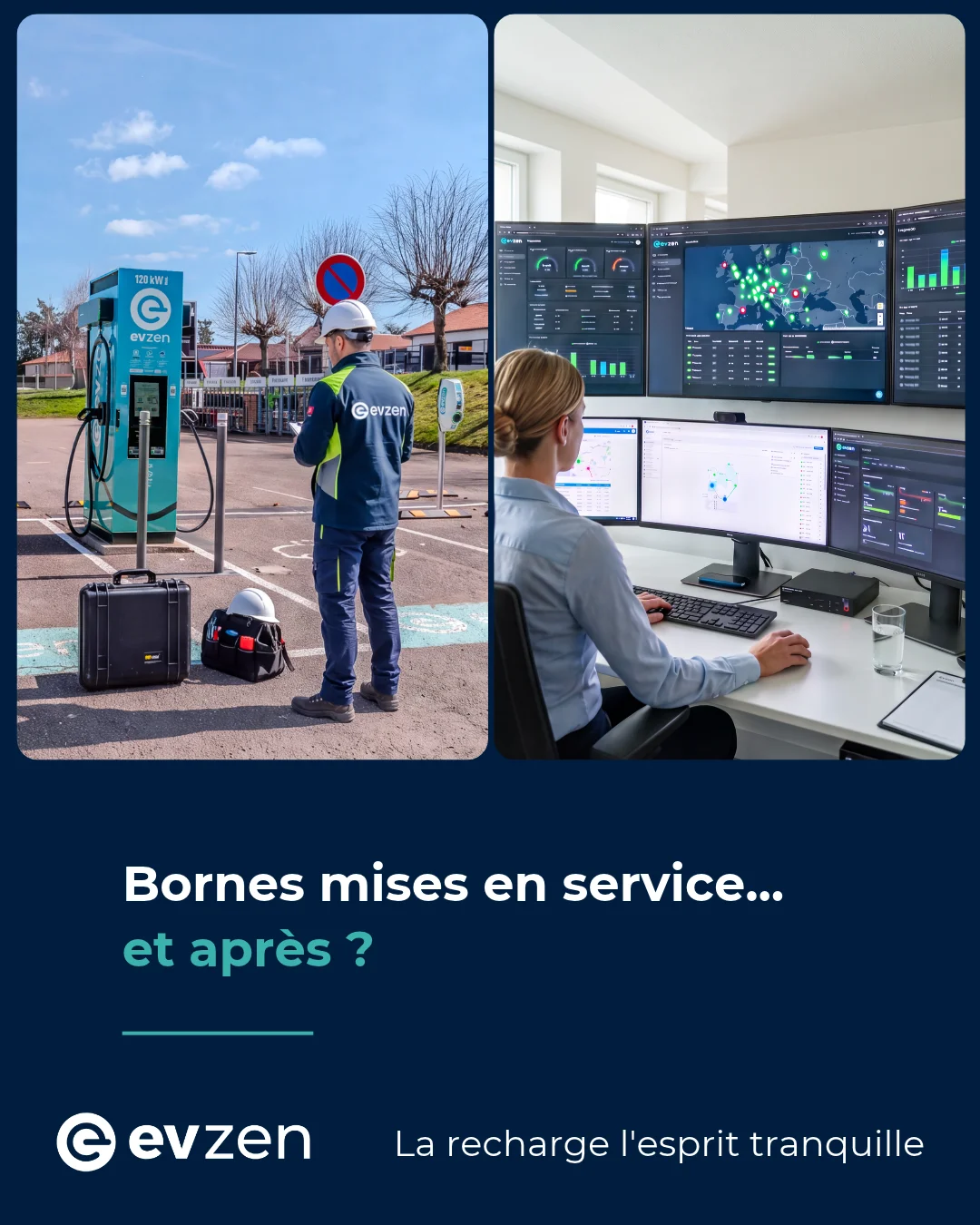
When a new charging station opens to the public, the project may seem complete: the chargers have been installed, the grid connection is operational, and the first vehicles can start charging.
In reality, a new phase is just beginning: operations.
A charging station is an infrastructure that needs to work day after day, serve different users and provide a charging experience that is as simple and reliable as possible. To achieve this, it must be monitored, maintained and managed over the long term.
At EVzen, this reality shapes our approach from the very beginning of a project. Because we believe that those who will operate the station tomorrow should also help shape it today.
Commissioning is only the beginning
Once opened to the public, a charging station enters its operational phase.
Every day, it must be able to deliver the expected charging power, initiate charging sessions correctly, process payments and provide the data required for its operation.
Behind what has become a simple action for EV drivers, plugging in a vehicle and starting a charge, lies an entire technical and operational chain.
The challenge is no longer simply to install charging points, but to maintain a reliable and high-performing charging service over time.
Monitoring to detect issues and take action
Operating a charging station relies heavily on remote monitoring.
Equipment and charging sessions are monitored remotely to oversee the station’s operation and identify potential issues.
This makes it possible to monitor, for example:
- the status of charge points;
- the successful completion of charging sessions;
- charging and payment data;
- alerts and faults reported by the equipment;
- the station’s overall performance.
When an issue occurs, certain actions can be carried out remotely. If this is not enough, an on-site technical intervention can be arranged.
The objective is simple: identify issues as quickly as possible and minimise their impact on users.
Maintaining equipment over the long term
Like any technical infrastructure used on a daily basis, a charging station also requires appropriate maintenance.
This generally involves two complementary approaches.
Preventive maintenance involves regularly checking equipment and anticipating potential failures that could affect its operation.
Corrective maintenance comes into play when an issue occurs and requires diagnosis, remote action or an on-site intervention.
Together, these measures help maintain equipment performance and the quality of service provided to EV drivers.
The user experience is shaped at the moment of charging
For EV drivers, all the technical complexity behind the infrastructure should remain in the background.
When arriving at a charging station, expectations are straightforward: find an available charge point, easily understand how to start a charging session, pay using one of the available payment methods and leave with enough energy to continue the journey.
This is precisely when users form their perception of a charging network.
A station may have been perfectly designed and installed, but if it is not properly operated over time, the user experience can quickly deteriorate.
That is why operations should never be considered a secondary phase of the project. They are an integral part of delivering a high-quality charging service.
Thinking like an operator from the design stage
The future quality of operations also depends on decisions made long before the station opens.
Equipment location, system sizing, available power, charger selection, electrical architecture, connectivity and ease of access for maintenance operations can all have an impact on the station’s day-to-day operation.
At EVzen, we therefore integrate this operational perspective from the study and design stages of every charging station.
This continuity ensures that the way a station is built is always considered alongside the way it will ultimately be used and operated.
EVzen: from initial study to ongoing operations
For its public ultra-fast charging station projects, EVzen is involved throughout the entire project lifecycle:
Study & Design
Site potential analysis, feasibility study and station sizing.
Implementation
Grid connection procedures, civil and electrical works, equipment supply and installation.
Commissioning
Testing, configuration and opening the station to users.
Monitoring & Operations
Monitoring station performance, managing charging sessions and payments, and overseeing day-to-day operations.
Maintenance & Support
Preventive maintenance, remote diagnostics, on-site technical interventions and 24/7 user support.
Managing the entire project lifecycle allows operational requirements to be integrated from the design stage onwards and ensures continuity between the station we build today and the service we need to deliver tomorrow.
A charging station is, above all, a service
Deploying charging infrastructure is about much more than simply installing electrical equipment.
A charging station is designed to operate for years, serve EV drivers every day and form part of a network whose quality depends on its availability and reliability.
That is why, at EVzen, we do not only think about commissioning.
We think about everything that comes after.
